The Spiral Continuum · Timeline
King Turn Three: Raimundo da Costa arrives with the atlas
The atlas with the 1567 endpaper anachronism — locked dangling
Location. The Coimbra college, Almeida's cell
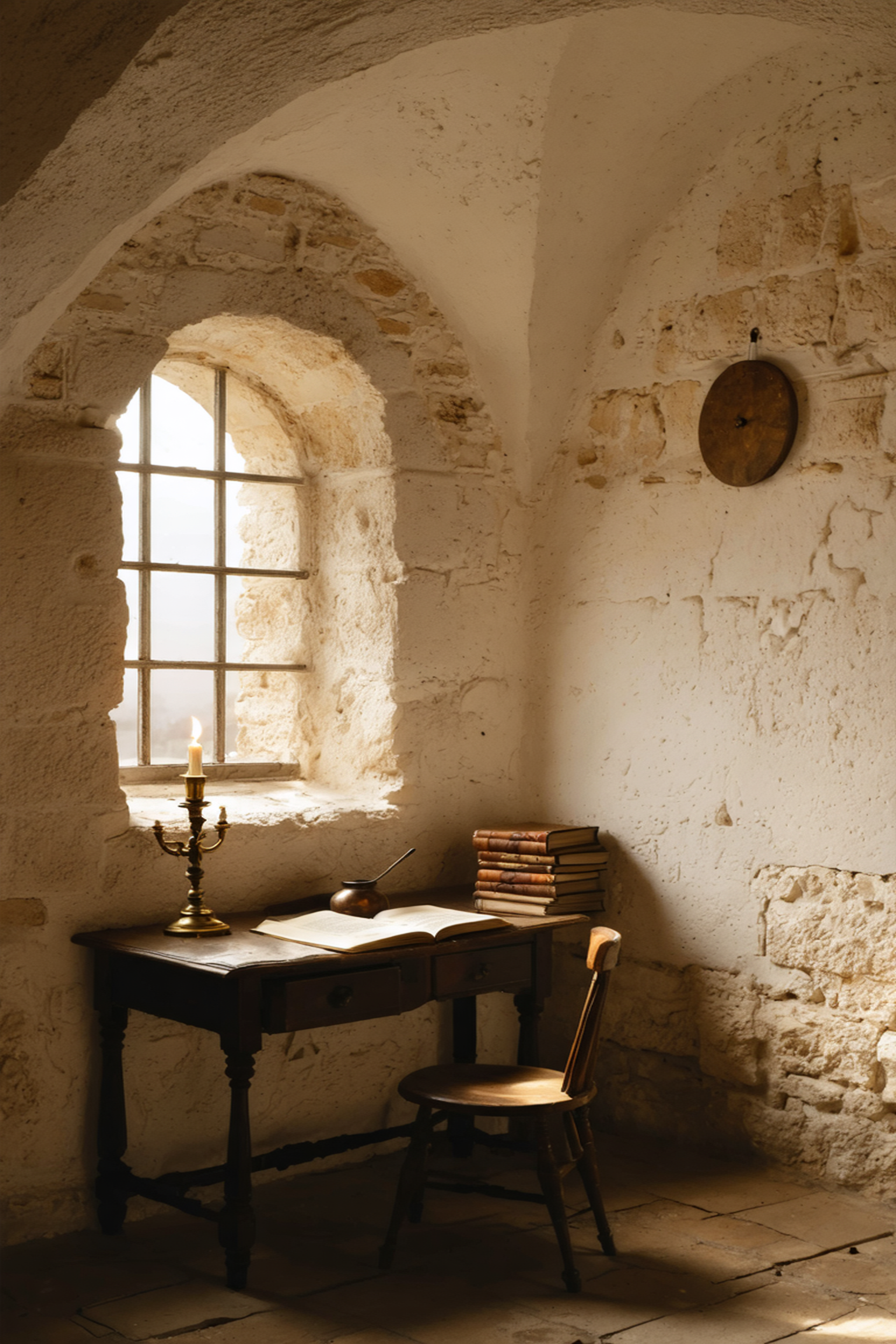
Padre, what do you see?
Raimundo da Costa is fifty-five. He took the first name in religion of Almeida’s elder blood brother at the deathbed in Goa in January 1611. He has corresponded with Almeida for forty-one years by Society packet. He has never met him.
He arrives on a Thursday evening in early November 1652. The Coimbra college’s porter, who has been receiving the same blessing from the same priest at the same gate every morning since 1641, sees a man in the gateway he has not seen before — a man weather-darkened, sea-thinned, foreign to the inner court — and steps aside.
Almeida is at the gate before the porter can announce him. He has not been at the gate to greet a visitor in eleven years. He embraces Raimundo before either has spoken. The embrace honours the elder Raimundo. Both men know it.
The atlas does not come up that night. It does not come up the next morning. It does not come up across the four days during which Raimundo settles into the visitor’s room in the procurator’s house, takes meals with Almeida in the priest’s cell, walks the cloister at the hour Almeida walks it.
On the fifth day, Thursday evening, Raimundo sets a small leather case on Almeida’s desk. He opens it. He places the atlas on the desk, closed, the front cover up.
Padre, what do you see?
Almeida is looking at the spine. He has, two weeks ago, in a moment of dictation, told the scribe-boy GOA 1551, and the scribe-boy has recorded the phrase three times in the margin of three separate dictation sheets. Almeida has not understood why those three words have been coming to him.
He sees them now. The spine reads GOA 1551 in iron-gall and the date is faded to bronze.
He opens the atlas. He looks at the front endpaper. He looks at it for what feels to him, at a hundred-and-fourteen years old, like the entire reading of his life.
On the endpaper there is an oxblood anchor stamp. The stamp is the Society’s. The date inside the stamp — 1567 — is in Arabic numerals. The hand that has written the 1567 has not held an Arabic numeral often. The 5 is shaped like a 5 by a hand that has just learned what a 5 looks like.
Across the stamp, in the same hand, is a monogram: J.A.
The monogram is his.
The handwriting is his.
He has not seen the atlas before this week. He has not been in Asia. He has not held a stamp like this in his hand. The endpaper, by every chronology he can construct, cannot have been signed by him.
It is signed by him.
He does not speak for forty seconds. Raimundo waits. Raimundo has come twelve thousand miles for those forty seconds.
Almeida closes the atlas. He looks across the desk at Raimundo. He says, in Portuguese:
I do not know how.
He will spend the next ten months annotating the atlas. He will add marginalia in his late hand on the back of plates that arrived in the Society archive in Goa in 1612 — annotations he will write knowing that they have always been there, will always have been there, even though he writes them in 1652 with the candle low and his hand careful.
The endpaper anachronism is locked dangling. It will not be solved. Aurora Pacheco Coutinho, on a winter afternoon in 1934, will open the same endpaper in her kitchen at Cabeceiras de Basto and recognise her own hand on the 1567 monogram. Cassandra Veyra, in 2027, will open the atlas at the Lapa writing-desk and see the 1567 and the J.A. and not move for half an hour.
The line writes both ways through time.
The audience identifies herself in every century she enters.
Almeida will die in eleven weeks. He will not know how the endpaper was signed. He will not need to.
⊕ Characters present
| Name | Role | Age |
|---|---|---|
| Padre João de Almeida | the priest | 114 |
| Padre Raimundo da Costa | renamed novice — took the elder Raimundo's first name at the Goa deathbed Jan 1611 | 55 |
⫢ Objects present
| Item | Provenance & note |
|---|---|
| The small atlas | bound Goa 1551, additional plates Manila 1606, Macau 1607, into the Society archive Goa 1612; carried Goa → Coimbra by Raimundo, Oct–Nov 1652 |
| The front endpaper | oxblood anchor stamp + J.A. monogram + the date 1567, in a hand not practised in Arabic numerals |
| Almeida's late hand | begins its first plate-back annotations the next morning |
☰ Books covering this event
| Volume | Title | Role |
|---|---|---|
| Book 4 | The Cipher of Origins | primary — Ch.39 |
| Book 5 | The Audience Name | the same atlas arrives at Aurora's kitchen — 282 years from now |
| Book 1 | The Cartographer and the Atlas | the same atlas arrives at Elias Quinn's apartment — 374 years from now |
∿ Where this sits in the era
The bright marker is this entry. The other markers are the other canonical events in the same era of The Spiral Continuum.